
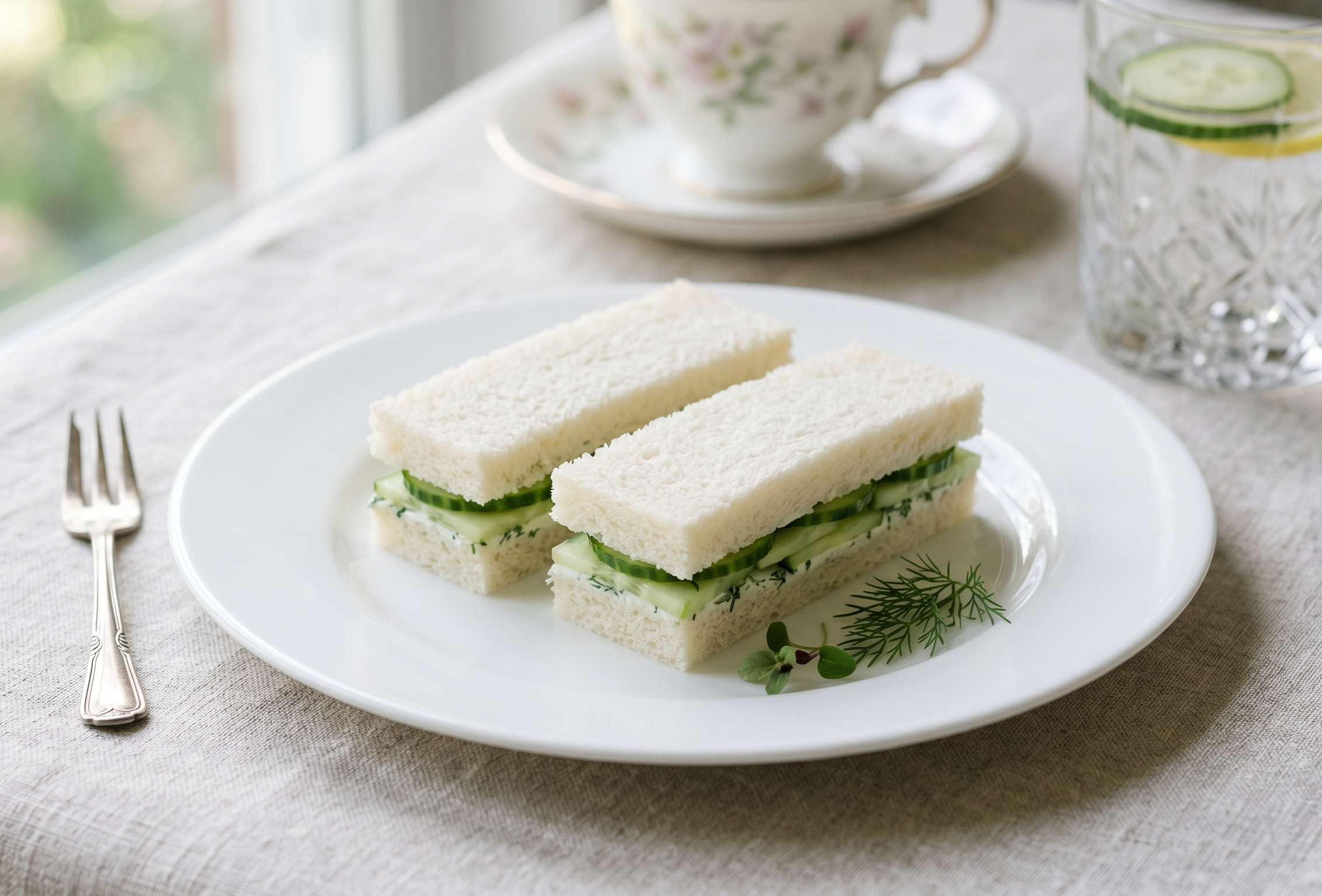
The Quietest, Most Correct Sandwich Ever Made
We end June — thirty recipes, five categories, one month of cooking that ranged from slow-roasted pork shoulder to the biochemistry of sleep teas — with a cucumber sandwich. Thinly sliced cucumber. Softened butter. White bread. That’s it.
I am not being ironic.
The cucumber sandwich is the most misunderstood entry in the sandwich canon. It gets dismissed as fussy and insubstantial — the food of garden parties and afternoon teas, of a certain kind of English restraint that modern cooking has largely moved past in favour of things that are bigger, louder, and more aggressively flavoured. And this dismissal misses the entire point, which is that the cucumber sandwich is not trying to be big or loud. It is trying to be cool, clean, delicate, and precisely satisfying in a way that no amount of additional ingredients would improve.
Cucumber is 96% water. Its flavour is subtle — grassy, faintly sweet, refreshing in the specific way that things which are mostly water and very cold are refreshing. Against salted butter and soft white bread, it is not bland. It is precise. It is a sandwich that knows exactly what it is and requires nothing more.
The execution, as always, is where people go wrong. Cucumber sliced too thick becomes watery and assertive. Bread that isn’t fresh becomes the dominant flavour. Butter applied cold tears the bread and distributes unevenly. These are small details that are, in a sandwich with three ingredients, everything.
Ingredients :
(serves 1, makes 2 finger sandwiches)
- 2 slices of fresh white sandwich bread — medium thickness, not artisan sourdough. This is the one recipe where good soft white bread is the correct answer.
- 1½ tbsp unsalted butter, properly softened to room temperature
- ¼ cucumber, sliced paper-thin — 2-3mm maximum. Use a mandoline if you have one. A sharp knife and patience if you don’t.
- Flaky sea salt
- White pepper — not black, which is too assertive here
- Optional: 1 tsp finely chopped fresh dill, or a few fresh mint leaves, or a thin scrape of cream cheese beneath the butter

Method :
- The butter must be soft — genuinely soft, spreadable without any resistance. Cold butter tears bread. Take it out of the fridge at least 30 minutes before making this sandwich, or it will not go well.
- Slice the cucumber as thinly as you can manage. Paper-thin is the goal — you should be able to see light through the slices. Too thick and the cucumber dominates and releases too much water too quickly. Lay the slices on a paper towel and press another towel on top for 2 minutes to draw out excess moisture. This prevents the sandwich from going soggy.
- Spread the softened butter generously on both slices of bread, covering every millimetre of surface including the edges. The butter is not just flavour — it is the moisture barrier that keeps the bread from absorbing cucumber water.
- Lay the cucumber slices on one buttered slice, overlapping them slightly so every bite has coverage. Season with flaky salt and white pepper. Add dill, mint, or cream cheese if using.
- Press the second slice on top, butter-side down. Press gently but firmly with the flat of your hand.
- Trim the crusts. I know this sounds precious. It is not precious — the crust has a different texture and moisture content that alters the delicate balance of the sandwich. Remove them. This is one of the cases where the old rule exists for a good reason.
- Cut into rectangles or triangles — rectangles if you want to be traditional, triangles if you want to feel better about Tuesday. Eat immediately, or cover with a slightly damp cloth and refrigerate for no more than 30 minutes.

Slice the cucumber as thinly as you can manage.
You should be able to see
light through the slices.
PRO TIP :
The cucumber sandwich, perhaps more than any other recipe in this entire series, rewards the quality of its ingredients disproportionately. Good butter — properly cultured, European-style, with a higher fat content and actual flavour — makes a meaningful difference here in a way that would be undetectable in a bolognese.
Fresh bread, ideally from a bakery that day, makes a meaningful difference. These are the recipes where the budget spent on quality ingredients has the highest return. Simple food holds nothing back and hides nothing.
Buy the good butter. Just this once, if not always.
And if you want to know which butter specifically — because you’ve come this far and you deserve a name — it’s Bordier.
Jean-Yves Bordier is a French artisan butter maker based in Saint-Malo, Brittany, and what he produces is not grocery store butter with a better label. It is butter made the old way — from cultured cream, churned slowly, worked by hand, salted with fleur de sel.
The texture is denser than anything you’ll find on a supermarket shelf. The flavour is complex — slightly tangy from the culture, rich from the fat content, with a clean finish that lingers.
On a cucumber sandwich, spread thickly on fresh white bread, it doesn’t just carry the sandwich. It becomes the reason for the sandwich. It is available online and at select specialty food shops.
— ” It is not cheap. It is correct. ” —


Leave a Reply